Yesterday we met with San Francisco Fashion Designer Colleen Quen in her Soma Atelier. True to form, Colleen was everything one would want to meet in a designer - Poised, kind, generous and SO inspiring! She was naturally engaged with our guest bloggers - Emilie, Maya, Cate, Jocelyn, Emma & Lucy. I'm sure you are excited to hear the interview so here goes -
Emilie -What is your favorite fabric to work with?
Colleen -
Definitely my favorite fabrics are French Lace and more structural fabrics like Matte Satin.
Emilie- Do you design anything other than gowns?
Colleen-
A full range of things. I love doing costumes for the Ballet, and travel/casual wear with multiple shapes and patterns of fabrics.
Emma -Where did you go to school?
Colleen -
I studied Fashion Design at FIDM in San Francisco and then I studied Couture Pattern Making with Simone Setha.
Emma - When did you start sewing? How Old were you?+
Colleen -
I learned from my mom, mostly, when I was about 6.
Jocelyn - Tell us about your process.
Colleen -
A client will call me and I'll set up an appointment. She'll come in and have an event to go like the opera opening and there will be a theme like Madame Butterfly or Turandot. She'll have an idea about color or theme. I'll get to know the client, really well and understand what kind of style she really likes. The next step is that I'll create some concepts for her. I'll make some fashion illustrations - some designs for her. Maybe 4 or 5 concepts and suggest some fabrics. It's almost like a little mini-program - each person. It's kind of a long process.
And then she comes back again and decides on the design. Then I'll start doing the pattern work. I have to measure her body. There are about 36 measurements to take and we'll map her body. Then I'll make the pattern and do the pattern work. Afterwards, I hand it to my seamstress who sews it in muslin. We always do one muslin fit. It's really important to do a muslin sample because sometimes the fabric is so expensive, we don't want to cut into the fabric. Once we get the initial fitting done and then we can sew it up in fabric.
Jennifer - How many times do you fit it in the Real Fabric?
Colleen -
about 2 or 3 times - because sometimes they loose weight or forget their shoes.
Jocelyn - How long have you been designing?
Colleen -
I started with skating costumes when I was 25. I've been creating for 25 years. I stopped Ice skating, but I do understand the body in that form. It's really important to do other things. Everything is incorporated into one. It helps make you a richer designer.
Cate - How much does the customer influence the design?
Colleen -
I do want to make sure to listen to my client to what they like and what they love. It's almost like a doctor experience when they come into the office. Since Ive been doing this for such a long time I've studied the body so much that I kind of know already what I can help them with. They ARE an influence, but hopefully I'm an influence to them. And as a designer, we are here to actually hem them, to complement them, and to take care of them. It's our job to guide them. To help them to look beautiful.
Jennifer - Yesterday, when we were watching The Secret World of Haute Couture, Karl Lagerfeld and John Galliano were talking about the relationship between the designer and client were really sacred. They didn't really want to say who their client were. Do you keep your clients a secret as well?
Colleen -
I do keep a lot clients very private especially the more high profile ones. I just want to keep it very private because It's a very personal experience when you are working with them. We do start discussing things so I do keep it very private out of respect. I only do that if someone wants to promote me or themselves. Otherwise it's a very personal private affair.
Cate - How do you choose the colors?
Colleen -
Actually I look at the person, the client, their coloring, their hair color, their skin color and also their personality. For some reason, I can extract out - like I can see people in colors. Sometimes I'll just start talking to you and I can feel the people's energy and I see colors in them and can start recommending colors to them. I'm not really into trends. So, It's not like "the hot color is green", so you've gotta wear green, because someone with a certain skin color doesn't looks good in green. I just try to understand who they are and how I can take them to the next level in there own personal way.
Maya - What inspires your designs?
Colleen -
In the beginning it used to be nature. Butterflies, birds and anything I was walking around looking at - a lady bug. It could be a dandelion.
Maya - we saw the Lady Bug Dress!
Colleen -
Yes, the Lady Bug Dress. Exactly. It could be an owl or flowers. I can see something wonderful in it and apply it to a garment. It's usually just things around me. Really, I like to just enjoy what's around me in the present moment and really not take anything for granted that inspires me. I don't like to limit what inspires me. It's really just what makes you feel beautiful. it's important that you just listen to your heart and go through it artistically too.
Maya - Who is your favorite Designer besides your self ?
Colleen -
I love Christian Lacroix. Have you heard of Victor and Rolf? They are kind of more Surrealistic an Avant Guarde I like looking for artists that think out of the box. Because it pushes you further than just being safe.
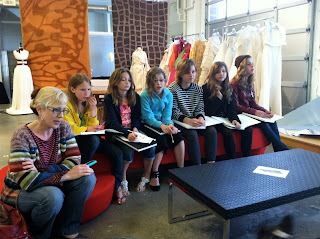 |
| Interviewing Colleen |
|
|
|
|
 |
| Colleen showing the girls around the Studio |
Lucy - How long does it take you to make a garment?
Colleen -
The beginning process takes usually a couple of weeks. When it's the sewing and the fitting - If it's a rush then it can take a month. Usually it takes two or three months. I've had wedding gowns that take up to 6 or 8 months. You get to meet their whole family.
Lucy - Do you hire anybody?
Colleen -
I have a very small company, but I do hire interns. When I have a collection, I hire 4 or 5 interns coming from school. They're with me through the whole collection until we have a fashion show. Sometimes we have a pretty big group. We may travel to Palm Springs together for a fashion show or we do an exhibit in a museum. I enjoy young energy coming into help because you can help me to be inspired.
Jennifer - So, one of the things we saw in the movie yesterday was that a lot of couture garments is sewn by hand. We are wondering how much of your collection is sewn by hand?
Colleen - W
ell, you know, I studied with Simone, and she studied in the 70's and it was getting to be less and less hand sewing. The hand sewing would be in the hems, as well as the waistbands inside, and sometimes closing up the linings. A lot of it is just straight stitching but with lots of very small stitches. It also depends on the thread quality, top stitching and the stretching. There is a little bit of dimension when it comes to sewing. What we actually do is steam and mold and stretch. You stretch and shape things with the iron. Have you ever seen hat blocks and how the fabric is stretched over the block? In French Couture Sewing we do a lot of stretching and molding the fabric. There is a lot of technique that comes with it and that's why you can't do mass production. There's those little details. And sometimes when I'm doing the sewing it's almost like a baby. Your fabric is like life. You're really molding and shaping it on the body.
 |
| Emma with Li Bi |
Cate - Which design are you most proud of?
Colleen -
My favorite one and it's a classic one, it's called Madame Butterfly.
 |
| Lantern Coat |
|
 |
| Li Bi |
 |
| Travel Coat |
|
 |
| Waterfall Dress |
Thank you Colleen for such an amazing and inspiring day!
Colleen Quen can be reached via her website at
www.colleenquencouture.com. She lives and works in her SF Studio with her Dog Li Bi.


